Pete Willis–Sally relationship
The Whisper ManThe Pete Willis–Sally relationship is defined by love that Pete believed he did not deserve and by the alcoholism that gradually made him into the man he feared he was. Their separation becomes one of the novel’s most persistent emotional absences: Pete preserves an idealized image of Sally as happy and safe somewhere in the world, until the truth of her death destroys that consoling fantasy. The relationship therefore functions not merely as backstory, but as the private history against which Pete measures failure, restraint, and the possibility of change.
Love Preserved in an Image
Pete repeatedly returns to an old photograph of himself and Sally, using it as the emotional centre of a ritual involving a bottle of vodka. The picture was taken on a summer day, with their faces pressed together. Sally is grinning in the sunlight, apparently full of joy, while Pete squints and smiles beside her. The photograph’s faded colours seem almost to be erasing the image, yet its material survival gives Pete a way to remain in contact with the relationship he lost.
The image records happiness, but Pete also reads warning signs into it. Sally’s eyes are open to the sun and her skin appears luminous, whereas Pete seems hesitant before the light, as if reluctant to let it enter. He understands that he loved Sally as deeply as she loved him, but that receiving love was difficult for him because he regarded himself as undeserving of it. His interpretation turns the photograph into more than a keepsake: it becomes evidence of both genuine intimacy and the weakness that would eventually damage it.
Alcoholism and the Failure of Partnership
Pete’s relationship with Sally is inseparable from his drinking. He understands that he slowly drank himself into the kind of man who could not sustain the love she offered. When he looks at her photograph, he repeats the lesson that drinking is what one loses, and that the loss is not worth the temporary relief. The words are not an abstract recovery slogan; they are tied to Sally’s face, to the life represented by the photograph, and to Pete’s recognition that alcohol displaced a relationship he valued.
Sally had tried to help him confront the self-hatred that governed his choices. At one point she encouraged him to make a list divided into positive and negative qualities, hoping that the exercise would show him that his attributes could balance his faults. It failed because Pete’s sense of worthlessness was too deeply embedded to be corrected by an inventory. He knew that Sally had tried hard to help him, yet he had repeatedly turned to drink instead. Their conflict was therefore not a lack of love, but Pete’s inability to allow love to alter the internal judgment he had already accepted.
Pete later describes his past drinking as having had many reasons, while insisting that reasons were not excuses. One of those reasons was his struggle to be a good husband. The admission places his failure within the relationship itself: he does not portray Sally as the cause of his addiction or reduce the separation to mutual incompatibility. He recognizes his own conduct as part of the damage, even while the shame surrounding that recognition continues to threaten his sobriety.
Separation, Memory, and Death
For years Pete sustains himself with the belief that Sally is alive somewhere, living the contented and loving life she always deserved. He treats the separation as a form of rescue, imagining that leaving him saved her from a life with him. This belief is painful and self-condemning, but it also allows him to preserve a future for her. Her imagined happiness becomes a moral counterweight to his own regret.
That belief is eventually exposed as false. Pete learns that Sally is dead, and the discovery removes the distinction he had maintained between his loss and her supposed gain. There had been no gain for her, he realizes; the life he had imagined for her did not exist. The revelation makes the relationship more final and more desolate, because he can no longer convert separation into the idea that Sally escaped into safety. The photograph remains unchanged, but its meaning darkens: it now holds a life that cannot be recovered rather than a person who might still be somewhere beyond Pete’s reach.
Pete’s grief is also shaped by belated understanding. Distance has allowed him to see his past more clearly, much as a battle can seem more intelligible from above, but that clarity arrives too late to repair the marriage or return Sally. His memory does not produce reconciliation with her; it produces a more honest account of what he did and what the relationship meant.
The Bottle, the Ritual, and Restraint
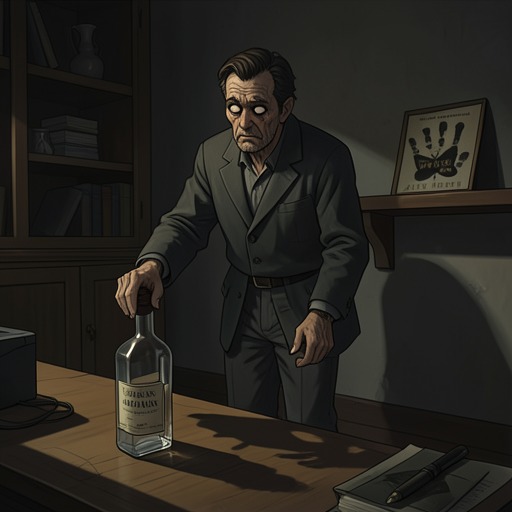
The bottle and the photograph recur together as a ritual object-pair. Pete takes the vodka from the kitchen cabinet, turns it in his hands, feels the thickness of the glass, and remembers the comforting click of breaking the seal. The physical bottle offers a protective barrier and a threat at once. Beside Sally’s image, it becomes the visible form of the choice Pete has made repeatedly: retreat into intoxication or remain exposed to memory and pain.
During the investigation involving Neil Spencer, the pressure intensifies. Seeing Frank Carter and hearing the killer’s account of a dream about Tony Smith bring older cases and darker memories closer to the surface. Pete sits at his dinner table with the kitchen dark and the living room silent, staring at the bottle and photograph for a long time. The urge to drink grows strong enough to feel inevitable, while the inherited voice of his father calls him worthless and useless. Sally’s photograph cannot erase that voice, but it gives Pete a concrete reason to resist it.
On another night, he carries the bottle and a tumbler to bed. In the morning the seal is broken, yet the bottle remains full. The detail marks a narrow but important victory: Pete has approached relapse closely enough to open the bottle, but he has not consumed its contents. Later, when he pours vodka into a glass, he decides that he will not drink that night. Rather than throw the glass, he walks to the kitchen and pours the liquid down the sink. The act is quiet and deliberate, and his thoughts turn not only to Sally’s photograph but also to Jake Kennedy, whose presence awakens a feeling Pete has not experienced in years.
What Sally’s Memory Makes Possible
The relationship’s lasting importance lies in the way its memory changes from a weapon of self-punishment into a resource for responsible action. At first, Pete uses Sally’s image chiefly to remind himself of what alcohol has destroyed. The photograph confirms his failure and helps him endure the urge by making the cost visible. Later, the same memory exists alongside the possibility that stopping can produce something rather than merely prevent another loss.
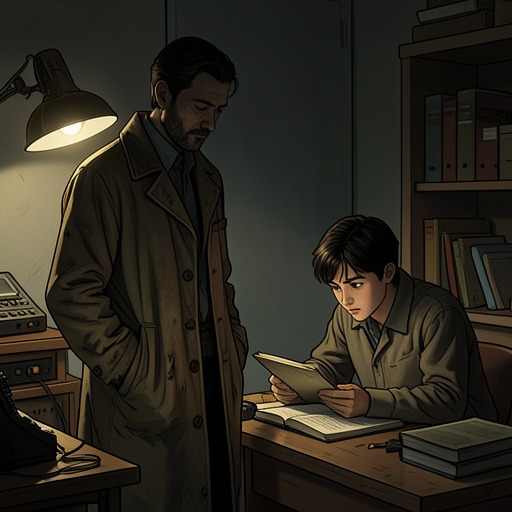
Reading to Jake becomes a decisive contrast. Pete watches the boy listen peacefully, then take over the reading with faltering delivery but impressive vocabulary. The scene makes Pete think about how badly he had damaged Tom Kennedy’s childhood, while also showing him that Tom had not passed that damage on to Jake. Looking down at Jake asleep and safe, Pete understands sobriety through a new emotional register: not only as the avoidance of Sally’s lost life, but as the preservation of a future relationship. The thought that drinking can cost something is joined by the recognition of what stopping can gain.
Even the final dreamlike encounter with Pete carries the shape of repair. A wounded man approaches his bed and embraces him; Pete senses, or imagines he senses, that embrace and feels understood and forgiven, as though a cycle has been completed and a missing piece returned. The scene does not literally restore Sally or undo the separation, and the text does not claim that Pete has escaped grief. Its significance is instead relational: the man who has long experienced love as something he could not receive is, at least momentarily, able to experience contact as forgiveness rather than accusation.
The Pete Willis–Sally relationship consequently remains both irretrievable and formative. Sally’s happiness in the photograph, her attempts to help him, the years of separation, and the later revelation of her death all converge in Pete’s struggle with alcohol. Her memory cannot save the partnership, but it helps him refuse another drink, imagine a different relation to Jake, and recognize that the future is not exhausted by the life he believes he ruined.